Bitcoin is more than a currency; it's a revolution restoring power to the people, offering a taste of peace and freedom in a world hungry for empowerment.
_My First Bitcoin_
In this concluding module, we'll summarize the lessons learned throughout our journey, ask and discuss a number of important questions, and explore the future of Bitcoin.
Bitcoin is not just a technology; it’s a network that powers a new form of money whose supply cannot be changed by any single party. Humanity has never had a form of money with a fixed supply and no centralized control. If widely adopted, Bitcoin is a tool that will unlock a movement for positive change that can transform the lives of people all over the world. It represents a peaceful revolution toward collective freedom and equity, opening up new opportunities for humanity by creating a shared, global monetary system.
As a decentralized global system, Bitcoin enables greater financial freedom, shifting power from the few to the many. It provides a secure, censorship-resistant platform for storing and transferring value, empowering individuals to take control of their wealth and protect their purchasing power. This is especially important in today’s uncertain economic climate, where the traditional financial system is facing unprecedented challenges.
Next, we’ll look at another form of digital currency called a Central Bank Digital Currency (CBDC) and evaluate how it is similar to and different from Bitcoin.
10.1 What are Central Bank Digital Currencies (CBDCs)?
Central Bank Digital Currencies, or CBDCs, are digital versions of regular fiat money. CBDCs follow the same rules as fiat money, where a central authority (like a government) can unilaterally expand the supply, reducing people’s purchasing power in the process. However, CBDCs also grant governments new and potent tools to control how that money is used by people around the world.
According to the Human Rights Foundation (HRF) research, 134 countries & currency unions, representing 98% of global GDP, are exploring a CBDC. In May 2020 that number was only 35. Currently, 66 countries are in the advanced phase of exploration—development, pilot, or launch. Every G20 country is exploring a CBDC, with 19 of them in the advanced stages of CBDC exploration.
So, besides being digital, what makes CBDCs different from regular fiat money? It's crucial to understand that, unlike regular fiat money in the form of paper or coins, CBDCs let the government digitally watch and control every transaction globally. This means the government can stop certain transactions or even freeze your whole account if they don't like you or how you're using your money.
For example, imagine you want to send money to a family member in a country that needs help, but your local government rejects your transaction because they disagree with that country's leaders. Or picture going to the store to buy something you like, but you can't because you expressed your opinion freely on social media.
Now, most of the fiat money in circulation is already digital — the difference being that it is a number of different banks that can monitor and censor transactions, and only those that pass through their accounts. Still, examples of censorship such as the above have happened and continue to happen in many countries, executed by banks but often at the behest of a central government.
CBDCs, however, give governments significant control over how money is used in their jurisdiction, limiting individuals’ ability to spend freely. Some argue that CBDCs could allow governments to enforce policies instantly, without human enforcement. Instead of coordinating with multiple banks, they could quickly track and block money flows within their country.
CBDC
Bitcoin
Unlimited supply
Limited supply
Centralized
Decentralized
Opaque monetary policy
Clear monetary policy
Closed & permissioned
Open & permissionless
Risk of seizure
Unconfiscatable
Privacy invasive
Privacy conscious
Enables censorship
Censorship resistant
Both CBDCs and Bitcoin are digital but, beyond this similarity, they represent very different forms of money with distinct philosophies, leading to different outcomes.
In Modules 5 and 8, we discovered that individuals who run a node help keep Bitcoin's rules safe. This is a big deal because, for the first time ever, people like us can be part of a network that ensures the rules of our monetary system are protected. These rules include the finite supply of money, and no one single party can change these rules. It's a unique opportunity for regular people to participate in keeping our money secure and reliable.
Bitcoin's philosophy is one of empowerment, freedom, financial independence, critical thinking, and self-determination — the idea that we should all have a say in the rules of the system we choose for ourselves. Unlike the fiat system controlled by powerful central parties, Bitcoin rests on a network where no single party has all the control. This means no one can take your property from you or stop you from spending your money the way you want. The exact opposite is true for CBDCs.
In the fiat world, having more wealth directly translates to having more influence and control. In contrast, Bitcoin distributes power to the people equally. It's a team effort where everyone, no matter how much money they have, plays a crucial role in the system. Picture it as a collective force, where your financial power doesn't automatically determine your influence. Bitcoin is built on unchangeable rules and, in this harmony, it's as if humanity itself is in control of the system. It's not a few big shots calling the shots — rather, it's all of us working together as a resilient community, guiding the course of Bitcoin without any single authority altering its path.
Whereas in the fiat system the powerful dictate the rules, in the Bitcoin ecosystem it is the addedcontribution of individuals that sustains the network. No single entity, regardless of wealth or power, can dictate the path of the Bitcoin ecosystem. It's an inversion of the traditional power dynamic, where the system's resilience lies not in the hands of the few but in the collective power of all participants.
The main idea is to create a safe, clear, and fair system where everyone can access, own, and spend global money, regardless of who or where they are.
Reflection: Do You Have the Right to Control Your Own Money?
Is access to money a human necessity and a human right? Why?
If you can’t spend your money however you want, send it to whomever you want, or take it with you to a new country, is it really yours? Why?
Why did barter stop being used? What is the problem of the double coincidence of wants?
Why is it important to understand the Nixon shock and its relevance for to this day?
Which other historical event we have studied is the most impactful for you?
How is money with a fixed supply different from traditional fiat currencies?
When was Bitcoin created, by whom, and for what purpose? How does the concept of a decentralized system contribute to this mission?
What are the different trade-offs associated with custodial and non-custodial wallets? Which was your favorite wallet?
What do you understand about the Lightning Network? What type of transactions would you use it for?
In what way does running your own node support the network?
How does having control over your own money empower you in your daily life and future planning?
In what ways can financial freedom enhance your ability to contribute positively to your community or society?
Hyperbitcoinization refers to a hypothetical future where Bitcoin has become the dominant global monetary system. This would mean that Bitcoin is being used by everyone, everywhere, and for everything — from buying coffee to paying bills, and even buying property. The growing interest in Bitcoin among individuals, businesses, and even governments highlights the potential impact of its widespread adoption on the global economy and society.
Here are some of the benefits of a hyperbitcoinized world:
A Self-Sovereign Future
A self-sovereign future is one in which individuals worldwide have full control over their own digital identity and assets. This could lead to greater financial inclusion, freedom, privacy, and security, thereby contributing to heightened human flourishing, abundance, and overall happiness.
A Reliable Store of Value
Bitcoin’s digital scarcity makes it the most reliable store of value in the long term, which encourages more and more people to use it as a means of saving for the future.
Changes in Monetary Policy
If Bitcoin were to become widely adopted, it could take away the ability of governments to expand the money supply through traditional monetary policy tools. Mass adoption of Bitcoin would potentially increase people’s purchasing power and encourage society to shift toward a lower time preference mindset.
Enhanced Transparency and Traceability
The tamper-proof and immutable record of all transactions on the blockchain would increase transparency and accountability in various industries and sectors. Currently, powerful entities have the ability to move trillions of dollars around the world without clear visibility into where these funds go or how they are utilized. By providing an open and verifiable record of financial transactions, Bitcoin could ensure that the movement of capital becomes more transparent to the public.
A Revolution in the Remittance Market
The remittance market involves the transfer of funds from one party to another, often across international borders. Despite declining costs, remittances remain relatively expensive compared to domestic bank transfers, especially for smaller amounts. The Lightning Network offers near-instant and inexpensive worldwide transactions, making it well-suited for the remittance market and addressing the high costs and other challenges associated with remittances, such as slow settlement times and restrictions on business hours.
Abundant Energy
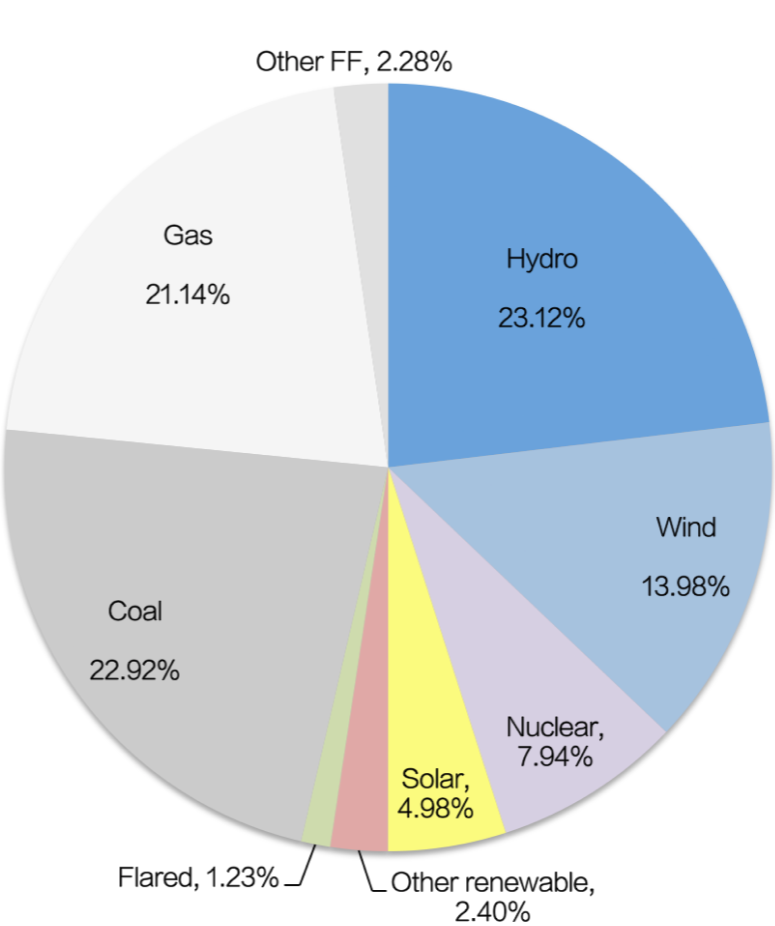
_Bitcoin Energy Sources. source: batcoinz.com / @dsbatten_
When there's a lot of affordable energy, societies do well, and many industries and communities can meet the increasing need for power in homes, businesses, and new technologies. Bitcoin mining incentivizes miners to use surplus energy that would usually go to waste from sustainable energy sources like solar, wind, and hydroelectric power. Bitcoin miners can tap into this cheap surplus energy to create new bitcoin through mining activities, secure the network, and offer excess energy they create back to the energy grid society uses when it is needed.
Money helps people communicate which activities, goods, and services are most important within society. When money is controlled by centralized authorities, it is inevitably manipulated.
One of the mistakes humanity keeps repeating throughout history is intervening in the free market, such as through the manipulation of money, which negatively affects individuals, families, businesses, and ultimately global human prosperity.
By taking the control of money out of the hands of centralized parties and instead using money with a fixed supply that no single party can change, we can create an entirely different world — one in which we don’t have to trust politicians to do the right thing, because doing the wrong thing has become very expensive and costly.
This is a fundamentally new world. And you can be a part of creating this reality. By using Bitcoin, running your own node, and helping your fellow humans learn more about the future of money, you are voting for a different world.
Activity: Final Discussion — How Did Your Perspective Change?
Please answer the following questions:
Why do we need money?
What is money?
Who controls money?
What gives money its “value”?
Write down the student questions that were selected during Module 1 and answer now.
Go back to the first activity in Module 1 and compare your new answers to your old answers.
Compare and discuss the original answers and questions. Did something change?
Ask yourself this final question: What is my next step? And how can I use this new knowledge to empower myself?
If you’re ready to take the next step, check out the additional resources in the following section, which contain the best resources for further learning and success.
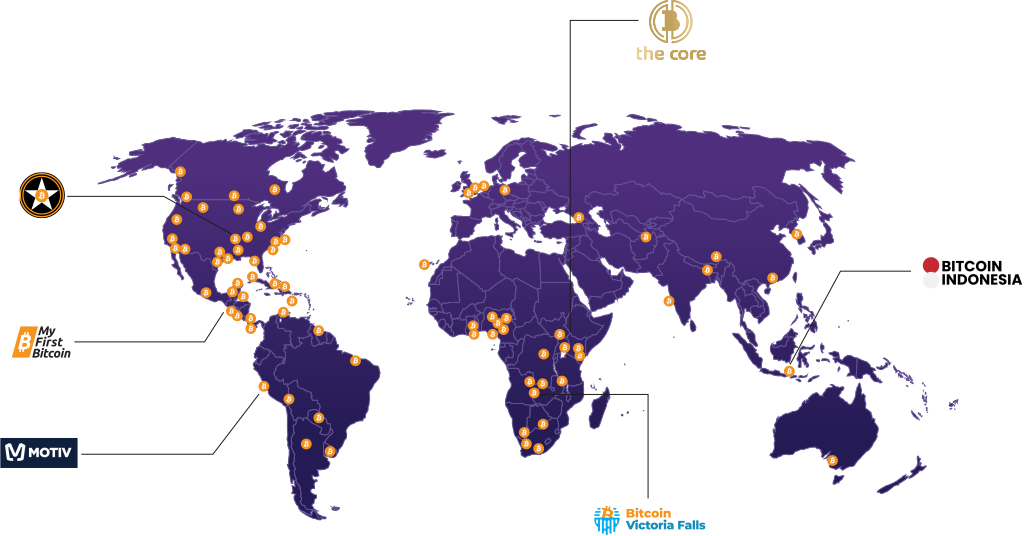
At My First Bitcoin, we believe in the power of communities and collaboration to bring Bitcoin education to every corner of the world.
That's why we have created the My First Bitcoin Education Network, an innovative initiative that seeks to decentralize education and empower local communities. As of April 2026, it consists of 80 communities from over 40 countries.
Let's hear their stories and learn how this Bitcoin Diploma has changed communities from all over the world!
Case Study: Bitcoin Indonesia
https://bitcoinindonesia.xyz/
Since 2023, Bitcoin Indonesia has been quietly transforming its country. Co-founder Diana explains more about the impact of independent Bitcoin education in Asia.
In September 2023, we hosted the first Bitcoin Indonesia Conference. When the last guest left and the chairs were stacked, we looked around and realized: nothing tangible remained. No lasting presence, no ongoing education. So a few of us, local Bitcoiners and friends, decided that we wanted a conference every day.
That’s how Bitcoin Indonesia was born.
By May 2024, we opened a physical hub: the Bitcoin House Bali. It’s where we started to orange-pill our local community. About half a year later, we connected with the My First Bitcoin team when the curriculum was translated by another community member. At first, we were skeptical, and thought that we could build a better program on our own: the Diploma was too long. Now, we believe that the Bitcoin Diploma is a shortcut in Bitcoin Education. It was rocket fuel. Besides benefiting from the curriculum, the teacher training program with a Full Node and also the Online School for digital classes have been very useful! We joined the Node Network, and the rest is history.
We’ve now graduated over 200 students across Bali, Bandung, and Surabaya, and hope to expand to Jakarta, Karawang, two local universities and many other places soon. And the graduates are not just “students.” Some of them run their own business and it has proven very easy to onboard students after doing in-person classes. A scooter mechanic now accepts Bitcoin, and a family business down the street too that sells Jamu, a Balinese herbal drink. Furthermore, graduates host their own cohorts or return as guest lecturers.
We’ve made the curriculum our own: translated it to Bahasa, added stories about the collapse of the local currency, the Rupiah, and explained satoshis through durian economics. The Rupiah is not divisible into cents or pennies, so we compare Bitcoin with a durian: as one fruit, with many pods and seeds in it. At the end of the cohorts, we celebrate every graduation as something special: with certificates, speeches, balloons, medals, and barbecues. Because when someone chooses to spend 10 weeks learning about financial freedom, that deserves to be rewarded.
Our classes are diverse: from 15-year-olds to elders, from tech-savvy investors to people who have never owned a laptop in their life. Some students had wanted to commit suicide because of shitcoin scams, and after joining the program they became part of our team and are spreading the word. Or others lost all their money in banking scams. They are now part of the closed loop circular economy. It’s been remarkable to see how students, who grew up in a communist country without critical thinking, start talking to each other about what they’re learning for the first time – instead of only reading aloud what’s written in the books.
It’s the first time in my life I feel that my work is making a real impact! It keeps me getting up every day. You can see the spark in their eyes, you can see they are hopeful again for a better future.
My biggest take-away to share with other educators is to make the lessons fun, and spark their curiosity. Just start simple, don’t make it too complex. Show why Bitcoin matters to your students individually, and speak from the heart. And before teaching online cohorts, definitely do an in-person cohort. I grew so much from teaching it offline first!
We always say that the My First Bitcoin program is so much better than you might think. We were very skeptical in the beginning and thought we’d never do it. It turned out to be one of the best decisions for the project.
Country
Language
Cohorts
Graduates
Classroom
Indonesia
Bahasa and English
15
282
In-person and Online
Case Study: The Core
https://www.thecore.africa/
What began as a simple WhatsApp group in Kenya has transformed into a global Bitcoin education movement, impacting over 300 lives across continents. Bitcoin education initiative The Core has been proven a life changer. Founder Felix Mukungu shares his journey.
It all started with an unfortunate experience: a crypto scam that ironically became my gateway to understanding Bitcoin. That experience showed me the technology was powerful, but I had been introduced to it all in a wrong way. At first, I wasn’t trying to build an education platform. I just wanted to understand everything, but all resources, articles, podcasts, and videos were fragmented. There was no structured path, no curriculum to guide people from the history of money to the future of Bitcoin. So I wrote my own: nine chapters with basic topics, sent over text in a WhatsApp group where anyone could ask questions. It was casual, but powerful. That’s how The Core began: from a desire to show people the right way.
Eventually, we moved to Google Classroom, hosting calls twice a week for a tight community of 10 students. Around that time, I also discovered My First Bitcoin through a Dutch Bitcoiner. Their curriculum was exactly what I had been searching for: organized, clear, and deeply aligned with my mission. I joined the Node Network in May 2023, and started teaching my first Bitcoin Diploma cohort. We had 30 subscribers and 12 graduates. Over time I got more and more help from guest teachers, for example Glenn from Bitcoin Ubuntu.
As an online platform, we found the Bitcoin Diploma and the Online School very useful. The Learning Management System (LMS) allows us to embed videos, slides, quizzes, assignments, and discussions. It’s a professional setup, and students take it seriously. They receive notifications as reminders to complete tasks. Besides that, the General Assemblies with other nodes have been very inspiring. You join and see what’s happening in other communities. You come out of these monthly meetings very motivated. The network of builders inspired to continue building.
Over 500 students have gone through our nine cohorts. We gift students sats, hand out certificates, and celebrate every step of the journey with our Bitcoin Pathfinders threads on X.
The Core has proven to be a foundation for other projects. From our very first cohort came Rikto Xonghoti in India, and since then more than 10 new projects have emerged, including Yes Bitcoin Haiti, Bitcoin School Kenya, and Kabul Bitcoin. In all cases: students turn into teachers! Some are starting circular economies like Bitcoin Githurai, supported by the very people who studied online with us.
Most students come from across Africa—Nigeria, Kenya, Ghana, Zambia, and more. Early cohorts were filled with tech-savvy learners, but now, the ripple effect is real. Graduates bring in their families, their friends, their neighbors. I’ve received messages from a daughter with her mother buying Bitcoin together. Or a story from an entire family who joined a cohort. The father who didn’t graduate at first, but he re-enrolled for the next cohort.
Our biggest highlight? A physical graduation, a side event during the African Bitcoin Conference, where the students met global Bitcoiners face-to-face. And receiving our first grant from the Human Rights Foundation was a big milestone too. What began as text messages via WhatsApp, has turned into a team of four who educate people from all over the continent in the right way.
My advice to anyone teaching the Bitcoin Diploma?
Start simple. Choose a low time preference. Create proof-of-work. Build first, apply for funding later.