Course Introduction: Explore the course objectives and expectations for the Bitcoin Diploma.
Class Discussion — Five Questions on Money: Engage in a reflective exercise by answering five key questions about money.
Understanding Money
Functions, Properties, and Types
Class Discussion — Why We Need Money
Psychology of Money
Module 2
Introduction to Money's History and Evolution: Explore the history and evolution of money. Understand how ancient forms of trade led to the development of the currency we use today.
Barter Game Activity: Engage in a hands-on barter game experience to grasp the challenges of direct exchange and appreciate the need for a more efficient system.
Evolution of Currency: Explore the transition from ancient forms like shells and beads to the emergence of coinage and paper money. Follow the journey from paper to plastic, unraveling the evolution of currency throughout history.
Digital Currency Revolution
Module 3
Fiat Money Origins: Explore the origins of fiat money through a brief historical overview, understanding how it became a dominant form of currency.
Fractional Reserve Banking Activity: Engage in the Fractional Reserve Banking activity to gain insights into how this system operates, highlighting its reliance on debt and the implications for the broader economy.
The Fiat System: Grasp the fundamental aspects of the fiat system, including its nature as a monetary system by decree, the role of fractional reserve banking, and the key players controlling this system.
Central Bank Digital Currencies (CBDCs): Explore the evolving landscape of Central Bank Digital Currencies (CBDCs) and their potential impact on the future of money.
Module 4
Decreasing Purchasing Power: Understand the concept of monetary inflation and its impact on purchasing power. Engage in the Effects of Inflation: An Auction Activity to experience the effects firsthand.
The Fiat System's Consequences Activity: Participate in the Consequences of the Fiat System activity, shedding light on the broader repercussions of the current monetary framework.
Global Debt Burden and Social Inequality: Explore the dual impacts of the global debt burden and social inequality. Recognize the individual and societal consequences, emphasizing the loss of purchasing power and the widening wealth gap.
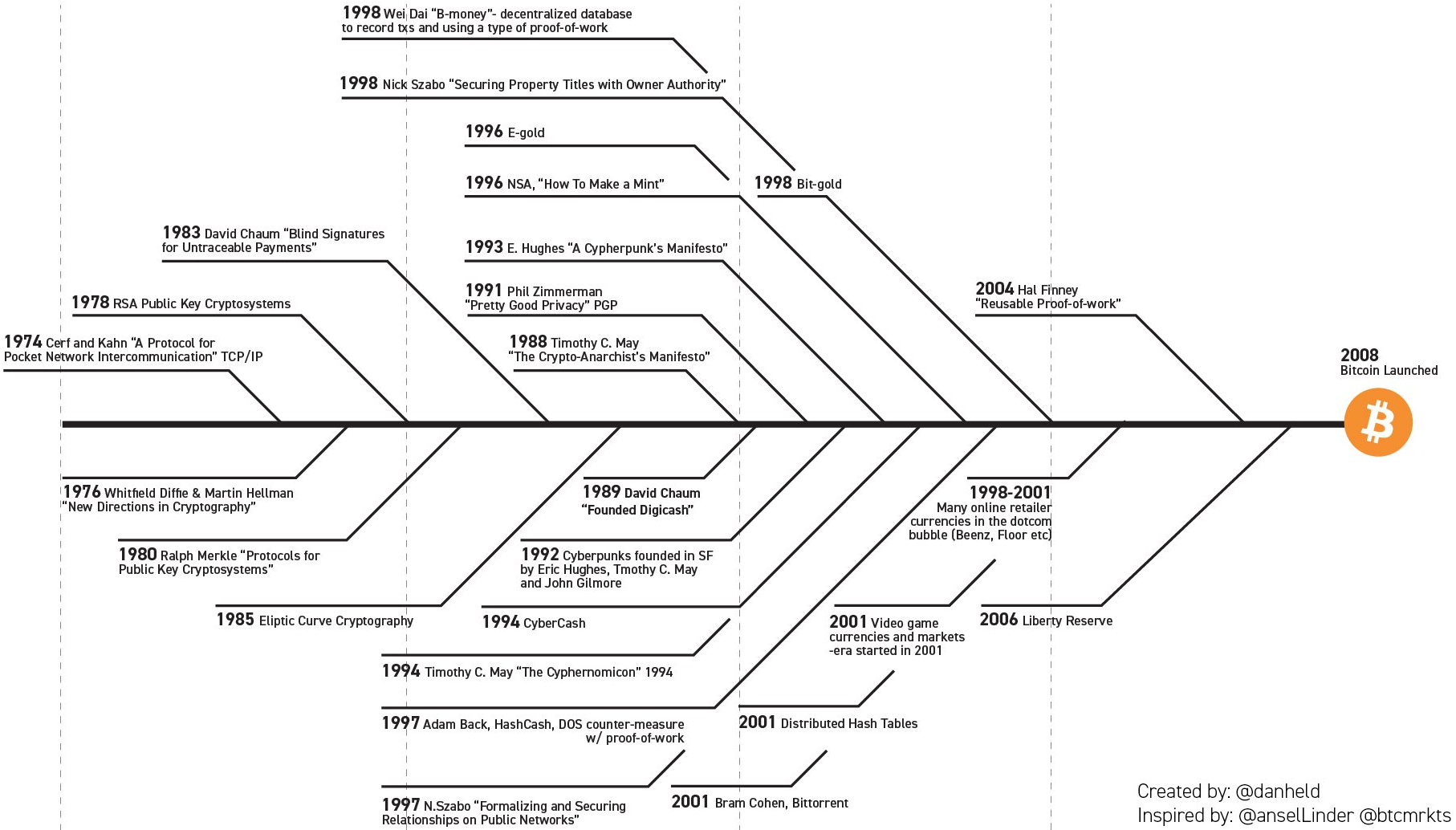
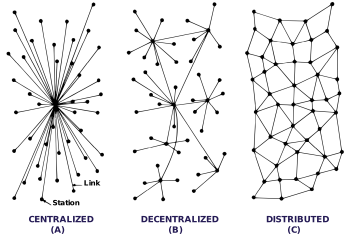
The Cypherpunks and Decentralization: Learn the Cypherpunks' story and their motivation for seeking a decentralized currency. Differentiate between centralized and decentralized systems, gaining insights from a brief history of digital currencies.
Module 5
Satoshi Nakamoto and the Creation of Bitcoin: Explore the mysterious figure of Satoshi Nakamoto and the origin story of Bitcoin, understanding the initial motivations behind its development.
Class Activity — Consensus Building: Engage in the Consensus Building in a Peer-to-Peer Network activity to gain practical insights into how consensus is achieved within the Bitcoin network.
Bitcoin as Sound Digital Money: Examine Bitcoin's role as sound digital money, discussing its evolution, functions, and properties, and participate in a class discussion on whether Bitcoin qualifies as sound money.
How Bitcoin Works: A look into the mechanics of Bitcoin, including the Nakamoto Consensus Mechanism. Identify the key players in the Bitcoin network, such as miners, nodes, users, developers, and projects, and grasp the collaborative dynamics between them.
Embracing Personal Responsibility: Emphasize the concept of personal responsibility in the context of Bitcoin, encouraging an understanding of individual roles and accountability within the decentralized ecosystem.
Module 6
Acquiring Bitcoin: Explore methods like peer-to-peer transactions and exchanges, discussing privacy concerns related to KYC processes.
Peer-to-Peer Transactions: Engage in decentralized transactions to experience the core principles of Bitcoin exchanges.
Setting Up a Bitcoin Wallet: Learn the essential steps to download, create keys, and back up a Bitcoin wallet for secure transactions.
Bitcoin Wallet Types: Differentiate between open source, closed source, custodial, and noncustodial wallets, understanding the role of keys in security.
Module 7
Introduction to Lightning Network: Recognize the evolution of Bitcoin through technologies like the Lightning Network, enhancing its capabilities.
Setting Up a Lightning Wallet: Learn the essential steps to set up a Bitcoin Lightning wallet, facilitating faster and more scalable transactions.
Hands-On Activity: Engage in a practical Lightning wallet relay race, promoting a dynamic understanding of Lightning Network transactions.
Lightning Wallet Types: Differentiate between open source, closed source, custodial, and noncustodial Lightning wallets for varied user preferences.
Lightning Transactions: Explore the process of sending and receiving Lightning transactions, emphasizing the speed and efficiency of the Lightning Network.
Module 8
The Bitcoin Ledger: Understand the concept of a decentralized ledger facilitated by nodes and miners, ensuring transparency and security.
Public and Private Keys: Explore the significance of cryptographic security in Bitcoin transactions through public and private keys, along with an activity demonstrating SHA 256 hashing.
The UTXO Model: Grasp the Unspent Transaction Output model as a fundamental aspect of Bitcoin's transaction process.
Module 9
Bitcoin Nodes and Miners: Look into the roles of nodes and miners in maintaining the Bitcoin network, covering aspects like issuance, scarcity, halving, and difficulty.
The Mempool: Explore the Bitcoin blockchain through the mempool and get hands-on experience through the mempool.space activity.
How Bitcoin Transactions Work: Gain insight into the entire lifecycle of a Bitcoin transaction, involving the sender, recipient, nodes, miners, and the mempool.
Module 10
Bitcoin's Future: Delve into the potential trajectory and future developments of Bitcoin as a revolutionary digital currency.
Central Bank Digital Currencies: Compare Bitcoin's decentralized ethos to that of CBDCs to better understand Bitcoin's role in empowering humanity.
Philosophical Underpinnings of Bitcoin: Explore the foundational philosophy behind Bitcoin, understanding how it emerged as a response to economic challenges, with a focus on its impact on financial freedom and how it differs from traditional currencies.
Diploma Reflection
curriculum-content/11-back-matter/4-glossary.md
Glossary
51% Attack: A type of attack on a blockchain network in which a single entity or group controls a majority of the network’s computing power, allowing them to manipulate transactions and potentially disrupt the network.
Atomic Swap: A peer-to-peer exchange of one cryptocurrency for another without the need for a centralized exchange or intermediary.
Auction: A process by which goods or assets are sold to the highest bidder.
Barter: The direct exchange of goods and services, without the use of intermediary goods, such as money.
Basket of Goods: A collection of goods or services used to measure changes in the cost of living.
Bitcoin: A decentralized protocol that allows people to send value to each other without intermediaries. The same name is used for the network of users and the currency native to the protocol.
Block Explorer: A tool used to view and explore the blockchain, allowing users to view individual blocks, transactions, and wallet addresses.
Block Reward: The amount of new bitcoin that are awarded to miners for adding a new block to the blockchain.
Blockchain: The public record of all Bitcoin transactions that have taken place, in the form of a chain of blocks.
Capital Controls: Restrictions on the movement of money across borders.
Central Bank: A government-owned institution that manages a country’s monetary policy.
Centralization: The concentration of power or control in a single entity.
Cold Storage: A method of storing bitcoin offline, away from the risk of hackers or other online threats.
Commodity Money: Objects used as a medium of exchange that are not anyone else's liability or IOUs, such as gold and silver.
Confirmation: The process of a Bitcoin transaction being added by a miner to the blockchain. Each new block mined adds a confirmation to that transaction, which becomes progressively harder (essentially impossible) to reverse.
Consensus Mechanism: A method used in blockchain technology to validate transactions and ensure the integrity of the blockchain.
Cryptographic Signature: A digital code generated using a private key to verify the authenticity and integrity of a message or piece of data and, in the case of Bitcoin, the ownership of a given UTXO.
Cryptography: A branch of mathematics that helps create secure systems.
Debasement: The reduction in the value of a currency, often by reducing the amount of precious metal in a coin.
Debt: Money that is owed to someone else.
Decentralization: The distribution of power and control across a network.
Decentralized Finance (DeFi): A movement within the cryptocurrency industry to create decentralized financial products and services that operate on a blockchain.
Digital Asset: A digital representation of value that can be traded or used as a store of value, such as bitcoin.
Distributed Ledger: A database that is spread across a network of computers rather than being stored in a central location.
Double Coincidence of Wants: Inherent problem in the barter economy, which requires each party in an exchange to want what the other has to offer, in that specific amount.
Double Spend: Trying to fraudulently spend funds which have already been spent. Fixed through centralized and permissioned oversight in traditional banking, and through code in Bitcoin.
Dust Transaction: A transaction that sends a very small amount of bitcoin that is too small to be economically viable.
Exchange: A platform where users can buy, sell, and trade cryptocurrencies for other assets such as fiat currency or other cryptocurrencies.
Exchange Rate: The value of one currency in relation to another.
FOMO: Fear of missing out, a term used to describe the feeling of anxiety or regret that one may miss out on a profitable opportunity.
FUD: Fear, uncertainty, and doubt, a term used to describe negative rumors or information that can cause market panic or decline.
GDP: Gross domestic product, the total value of goods and services produced in a country in a given period of time.
Hard Fork: A non-backward compatible change to the Bitcoin protocol that creates a new set of rules requiring new consensus, and resulting in two separate blockchains.
Hardware Wallet: A physical device used for generating, storing, and managing private keys, providing enhanced security over software wallets.
Hash Function: A mathematical function that takes input data of any size and outputs a fixed-size string of characters, commonly used in cryptography and blockchain technology.
Hash Rate: A way to measure the processing power of the Bitcoin network.
HODL: A term used in the Bitcoin community to describe holding onto Bitcoin long-term, rather than selling or trading it.
Hot Wallet: A Bitcoin wallet that is connected to the internet, allowing for easy access to Bitcoin.
Imports: Goods and services produced in another country and sold in the domestic market.
Inflation: An increase in the general price level of goods and services in an economy due to the devaluation of the currency.
Layer-1 Protocol: The base layer of the Bitcoin protocol that handles the fundamental aspects of consensus, transaction validation, and data storage.
Layer-2 Protocol: A secondary layer built on top of the layer-1, often used to enhance scalability, speed, and functionality.
Ledger: A record of financial transactions.
Lightning Network: A layer-2 payment protocol for smaller transactions that enables faster and cheaper Bitcoin transactions by using off-chain channels.
Medium of Exchange: Objects widely accepted in exchange for goods and services.
Merkle Tree: A tree-like data structure used in the Bitcoin blockchain to efficiently verify the integrity of large sets of data.
Mining Pool: A group of miners who work together to increase their chances of finding new blocks and earning bitcoin.
Mining: The use of computing power to do mathematical calculations designed for confirming transactions and increasing the security of the Bitcoin network.
Monetary and Fiscal Policy: The policies of a central bank and government, respectively, that influence the money supply and interest rates in an economy.
Money: A generally accepted medium of exchange, serving also as a store of value and unit of account.
Money Supply: The total amount of money in circulation in an economy.
Multi-Signature (Multisig) Wallet: A wallet that requires multiple signatures or approvals before a transaction can be executed, providing additional security and control.
Node: A computer or device that stores an independent copy of the Bitcoin ledger and is connected to the Bitcoin network, participating in the verification and transmission of transactions.
Node Network: A network of connected computers or devices that support and maintain the Bitcoin network.
Nonce: A random number added to a block header to create a hash that meets the difficulty target.
Orphan Block: A block not included in the main chain of the blockchain due to being invalidated by a longer competing chain.
Paper Wallet: A printed copy of a user's private and public keys used for storing and managing Bitcoin offline.
Peer-to-Peer (P2P): Refers to any direct interaction between two parties, without the intervention of intermediaries or third parties.
Peg: A fixed exchange rate between two currencies where one is pegged to the value of another.
Private Key: A secret random string of numbers that allows a user to sign messages and transactions, thus proving a person's right to spend bitcoin from a given UTXO.
Proof of Work (PoW): A consensus mechanism that requires users to perform a certain amount of computational work to add blocks to the Bitcoin blokchain.
Public Address: A unique identifier derived from a user's private key through a mathematical process known as one-way function and used for receiving bitcoin.
Purchasing Power: The amount of goods and services a unit of currency can buy, reflecting that currency's value in terms of what it can purchase.
Recover (Seed) Phrase: A series of 12, 18, or 24 human-readable words derived from the users's non-human-readable private key that makes it easier to secure. It can be used to restore a Bitcoin wallet.
Reserve Ratio: The proportion of deposits that a bank must hold as reserves.
Restrictive Banking: Restrictions or limitations on banking services or access to banking services.
satoshi (sat): The smallest unit of Bitcoin, equal to 1/100,000,000 of a bitcoin. It is named after the creator of Bitcoin, Satoshi Nakamoto.
Satoshi Nakamoto: The pseudonym used by the anonymous creator(s) of Bitcoin.
Satoshis per Byte (sat/b): A unit used to measure the Bitcoin transaction fee paid per byte of transaction data.
SegWit (Segregated Witness): A Bitcoin protocol upgrade that changes the way data is stored on the blockchain, allowing for increased capacity and lower transaction fees.
Sidechain: A parallel blockchain connected to the main blockchain, allowing for the transfer of assets or information between the two chains.
Smart Contract: A self-executing contract with the terms of the agreement written into code.
Soft Fork: A backward-compatible change to the Bitcoin protocol that allows updated nodes to still interact with non-updated nodes, maintaining consensus.
Stablecoin: A type of cryptocurrency pegged to a fiat currency or other asset.
Store of value: An asset which does not depreciate with time, allowing to transfer value into the future (saving).
Supply and Demand: The economic principle that the price of goods or services is determined by the interaction of the quantity of the goods or services supplied and the quantity demanded.
Time Value of Money: The principle that money is worth more in the present than in the future.
Trading Pair: A set of two currencies or assets that can be traded against each other on exchange (e.g., BTC/USD).
Transaction Fee: A small amount of bitcoin paid by the sender of a transaction, incentivizing miners to include the transaction in a block and add it to the blockchain.
Transaction ID (TXID): A unique string of numbers and letters that shows the details of a Bitcoin transfer (such as the amount sent, the addresses of the sender and recipient, and the date of the transfer) on the Bitcoin blockchain.
Transaction: The transfer of bitcoin from one address to another on the Bitcoin network.
Trustless: A system or process that does not require trust in any third party or intermediary. instead relying on the security and transparency of the underlying technology.
Two-Factor Authentication (2FA): A security measure that requires two methods of authentication, (typically a password and a separate code or device) to access an account or complete a transaction.
Unbanked: Individuals or communities without access to traditional banking services.
Unit of Account: A standard unit of measurement used to express the value of goods and services.
Unspent Transaction Output: A given amount of bitcoin resulting from a previous transaction and owned by the recipient's private key, making it spendable by that user.
UTXO Set: The collection of all Bitcoin UTXOs available to spend by their owners through their private key.
Volatility: The degree of variation in the price of an asset over time.
Wallet Backup: A copy of the recovery phrase of a Bitcoin wallet, which can be used to restore access to the wallet in case the original is lost or stolen.
Wallet: A virtual container for bitcoin similar to a physical wallet made up of the user's private key and those UTXOs owned by that key.
Whale: An individual or organization that holds a significant amount of any given asset, and thus capable of influencing market prices through large trades.
White Hat Hacker: An ethical hacker who uses their skills to identify and fix vulnerabilities in computer systems and networks.
Whitepaper: A report that outlines a project's concept, goals, technology, and implementation details. In Bitcoin's case, it is the foundational document penned by Satoshi Nakamoto which made the protocol public for the first time.
A lot of people automatically dismiss e-currency as a lost cause because of all the companies that failed since the 1990s. I hope it's obvious it was only the centrally controlled nature of those systems that doomed them. I think this is the first time we’re trying a decentralized non-trust-based system.
_Satoshi Nakamoto_
_Bitcoin prehistory - It’s the result of 40 years of research, development and demand_
As we saw in the previous module, several Cypherpunks tried to create an alternative form of money. This module continues the story of one of them: a visionary known as “Satoshi Nakamoto”. This anonymous figure (an individual or group), long before Bitcoin, took part in online discussions about cryptography and computer science to find practical ways to replace the fiat system.
https://bitcoin.org/bitcoin.pdf
In October 2008, Nakamoto unveiled a groundbreaking whitepaper titled “Bitcoin: A Peer-to-Peer Electronic Cash System” on a cryptography mailing list. This document laid the foundation for a decentralized peer-to-peer protocol designed to facilitate secure online transactions without the need for intermediaries. Nakamoto's vision was clear: to create a purely peer-to-peer version of electronic cash, free from the control of powerful governments and financial institutions.
Although Nakamoto’s identity remains unknown, their goal was clear: take power from the few and return it to the many by creating a decentralized, open-source, transparent money system independent of the state. Bitcoin was a response to the 2008 financial crisis, which hurt ordinary people while benefiting the elite. It offered an alternative to the corruption and fragility of the fiat system. Nakamoto laid the foundation for a new revolution and chose not to claim credit.
On January 3rd, 2009, Nakamoto mined the first Bitcoin block, known as the genesis block. This marked the launch of the Bitcoin network, a trustless system secured by a decentralized ledger.
In 2011, after proving the network could run without them, Nakamoto stepped away, leaving Bitcoin in the hands of others who shared the vision.
In the years that followed, more people joined and contributed. Bitcoin grew into a symbol of hope and empowerment, offering a secure, censorship-resistant way to transact. As an open-source protocol, no one can control it, and anyone can participate.
Today, Nakamoto’s vision of a borderless and transparent financial system lives on. People around the world are choosing Bitcoin, and circular economies are emerging in many regions.
So, how does Bitcoin work? Bitcoin has lots of features, and the rabbit hole goes deep — very deep. Fortunately, if you're entering the Bitcoin world for the first time, you do not have to perfectly understand how it works to start using it.
The same is true for the internet: most people do not know how the TCP/IP protocol works, yet they send emails and messages, and post content on their social media every day. It's just like driving a car — most people do not know exactly how a car works, yet they do know how to drive.
Callout – Bitcoin is not widely adopted yet
Bitcoin is not widely adopted yet. It is still a pretty new technology, like the internet was during the 90s. Because of this, it can be helpful to focus on the fundamentals of Bitcoin, rather than on its technical aspects.
The key idea behind how Bitcoin operates can be condensed into one sentence: Bitcoin is a common set of rules agreed to by all network participants. You can think about it as playing a board game with friends. In a game like Monopoly, you are in agreement with the other players about specific rules. One of the rules of Monopoly is that only special “Monopoly bills” are to be accepted. If James (one of the players) decided against the rules to use toilet paper instead of Monopoly bills to buy a house, the other players would tell James he is a cheater and would simply stop playing with him. In short, to play the game, you need consensus on a set of rules and to agree with each other not to deviate from those rules, or you will be rejected.
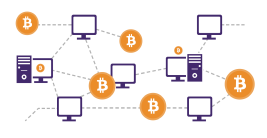
This is essentially how Bitcoin works. Bitcoin is a network of people that agree on the same set of rules. These rules are mathematically bound, written in computer code, and accepted directly by everyone who runs the Bitcoin software. The rules of Bitcoin apply to all participants equally, which means that each player either follows the rules of the game or cannot play because the network will reject them.
For example, one of the rules of Bitcoin is "There will never be more than 21 million bitcoin." If someone were to create a million extra bitcoins for themselves, it would be of no use to them, because they would automatically be identified and rejected by everyone else. This is what makes Bitcoin so robust.
Info
It does not matter who you are or where you come from: if you enter the Bitcoin world, you must play by the same set of rules as everyone else.
This also applies to all the people and entities with disproportionate influence in the fiat world. In the Bitcoin world, there is no room for cheating or sabotage — everyone is treated equally, and no one can change that.
Callout
Did you know that, since 2009, Bitcoin has withstood tens of thousands of attempts to hack, tamper with, or alter it? Bitcoin has consistently proven that nobody can stop, control, or manipulate it.
The Players of the Game
To better understand the decentralization of Bitcoin, we need to dive deeper into the different roles within the network. In the Bitcoin world, various participants play distinct yet harmonious roles, contributing to the protocol's seamless functioning.
1. Miners: The Architects of Security
Miners are the backbone of Bitcoin. They work behind the scenes to maintain and secure the network through a mechanism called Proof-of-Work (PoW).
These players are armed with special computers that boast heavy computational power. They make this power available to the Bitcoin network, competing with each other in a worldwide lottery to add new blocks of transactions to Bitcoin’s decentralized ledger (the blockchain). Their commitment ensures the the ledger's immutability and guards against malicious attacks.
The decentralized nature of mining means that anyone can participate — in practice, however, competition is fierce. As a reward for their contribution, the first miner who solves the puzzle is rewarded in the form of new bitcoin, an incentive known as the block reward.
Bitcoin miners are distributed all over the world, safeguarding the network against centralization and ensuring Bitcoin's security stays robust and distributed.
2. Nodes: Gatekeepers of Validation
Bitcoin nodes are run by ordinary people across the planet. These participants serve as the Bitcoin network's gatekeepers by running Bitcoin software on their computers on which they keep a copy of the entire ledger. Nodes validate transactions and ensure that all participants adhere to the consensus rules.
By distributing the responsibility of validation across a network of nodes, Bitcoin remains resilient against attacks and maintains its trustless nature. Nodes play a crucial role in upholding the integrity of the ledger, contributing to the Bitcoin's decentralization ethos.
3. Users: Empowered Participants
Users — the lifeblood of the Bitcoin network — are individuals who engage in transactions. You can think of users as regular people who just have empowered themselves by integrating Bitcoin into their lives. For example, some users save their money in bitcoin while others use it as money to buy groceries and receive their salary.
Bitcoin empowers users by eliminating the need for intermediaries like banks and governments, allowing for direct peer-to-peer transactions. This also means that users have full control over their money and transactions.
4. Developers and Projects: Architects of Innovation
The monetary system of the future won't build itself, nor will it be globally adopted in an ethically correct way without effort. That’s where Bitcoin developers and projects come into play. Developers wield their technical expertise to enhance and innovate on the Bitcoin protocol. These individuals contribute code, propose improvements, and address vulnerabilities, ensuring the network evolves in response to all types of challenges. Bitcoin's open-source nature invites collaboration, allowing developers worldwide to contribute to its growth.
The beauty of this decentralized development prevents a single entity from monopolizing control over the protocol. This happens through a consensus-driven process. Developers propose ideas and changes, and only those with the best ideas who are aligned with the broader vision for a better world receive support from the community, empowering Bitcoin's transparent and democratic evolution as it scales to 8 billion people.
Bitcoin projects involve diverse groups, from mission-driven nonprofits and corporations to groups and individuals who create valuable content. These people work together on a specific goal or focus within the bigger Bitcoin mission toward collective freedom. Bitcoin projects play a crucial role in shaping and promoting the adoption of Bitcoin, working toward a future that prioritizes the empowerment and freedom of the human race.
The Symphony
Bitcoin's decentralization can be thought of as a synergetic orchestra, a balancing act where all the different musicians make the most beautiful music together. There is no boss in the Bitcoin network: miners, nodes, users, developers, and projects perform their roles with autonomy and collaboration.
The decentralized ledger, maintained by nodes, guarantees transparency, while the proof-of-work mechanism provides security and deters centralization in mining; users experience financial sovereignty and empowerment, free from the control of the fiat system; developers, guided by consensus, ensure the protocol adapts to meet the evolving needs of humanity; Bitcoin projects, in their own unique ways, contribute to the broader mission of collective freedom.
Each participant in this decentralized orchestra plays a vital role in shaping Bitcoin's adoption and empowering humanity, contributing to the resilience and longevity of Bitcoin and creating a trust-free, borderless and empowering ecosystem.
Callout – Summary
The symphony of decentralization in Bitcoin resonates as a testament to Satoshi Nakamoto's vision and the immense passion of a global community seeking freedom and empowerment.
Activity: Consensus
https://qr.myfirstbitcoin.org/consensus.pdf
This is a class exercise where participants learn firsthand how difficult synchronizing actions is in a group without a defined leader. The intent is for participants to understand how agreement (consensus) is achieved in Bitcoin.
Key Points
Consensus = agreement
One big difference between a group with centralized control and one without is the question of trust. Decentralized groups like peer-to-peer networks do not have a leader and participants do not trust each other. They require a different way to coordinate.
For developers of peer-to-peer networks, this is known as the Byzantine Generals Problem. Bitcoin solves this challenge with math and proof-of-work mining.
Bitcoin being decentralized is critical to its value. Historically, human leaders always succumb to the temptation to debase money over the long term.
The Nakamoto Consensus is named after the creator of Bitcoin, Satoshi Nakamoto. This consensus mechanism is how thousands of strangers who do not trust each other have maintained the Bitcoin ledger since 2009.
In the simplest terms, Bitcoin is money. Bitcoin is not an investment but rather a safe, empowering way of saving your hard-earned money.
Holding bitcoin won’t make you rich because it won’t give you a return of more bitcoin. Its value, measured against any fiat currency, does go up; but this is only because of its growing adoption and the devaluation of fiat currencies.
Info
Bitcoin is money, used to store and send value.
It runs on a global network of computers.
That network is powered by real hardware.
People are motivated by incentives to keep it secure.
And it continues to improve through innovation.
These elements create an open and reliable system that anyone can use.
Bitcoin is a new form of money: it is “The Internet of Money", which means that it is open for anyone to join and start exchanging value with other users. Even the most isolated and poorest communities in the world finally have access to a monetary system. Just like everyone who has a phone and an internet connection can use a search engine, Bitcoin makes it possible for everyone with a phone and internet connection to access a new, global monetary system.
Faster, Cheaper Payments: Send money in minutes, with low fees.
Financial Inclusion: 2.5 billion unbanked people can access money.
Increased Privacy: Bitcoin transactions are public but your identity is not.
Note – Principles of Bitcoin
Bitcoin is built on three simple ideas:
* Decentralized: No one controls it. A global network keeps it running.
* Peer-to-Peer: People send money directly to each other without banks.
* Finite: There will only ever be 21 million bitcoins.
These principles make Bitcoin open, global, and independent.
Bitcoin is completely digital and borderless. It doesn’t matter where you are located because it lives on computers and smartphones from all over the world. Lots of users worldwide run the Bitcoin software and a copy of its ledger.
This software and record of all transactions has a very low chance of disappearing as there are countless copies of it. To shut it down, you would need to shut down the entire internet, forever — which is extremely unlikely to happen.
Finally, Bitcoin is scarce, which means that the number of bitcoin that will ever exist is absolutely limited. No one can counterfeit on-chain bitcoin — not even the most powerful governments and financial institutions.
Bitcoin’s Features
The Evolution of Sound Money
The lifecycle of sound money generally progresses through three stages to receive general acceptance from society: from being a store of value to becoming a medium of exchange and, finally, a unit of account.
The first stage of money, a store of value, is when a currency starts gaining trust as a stable (or appreciating) asset over time. People who recognize this early seek to protect their wealth by storing it in this form of money, especially during times of geopolitical and macroeconomic uncertainty.
Some groups, call Bitcoin a form of “digital gold.” This is because Bitcoin firmly established itself as a store of value during the past decade. Every day, more and more people start to view Bitcoin as a hedge against inflation, like gold was historically.
The next stage is when confidence in a currency's stability solidifies. This is when the currency transitions into a medium of exchange, facilitating transactions in people’s daily lives. During this stage, the currency starts to become widely accepted for the exchange of goods and services.
Bitcoin is progressively moving toward becoming a medium of exchange. With growing merchant acceptance and the development of the protocol, Bitcoin transactions are becoming more efficient and commonplace in daily commerce. Each day, more and more ordinary citizens and businesses are using Bitcoin as a medium of exchange.
In the final stage, a currency achieves the status of unit of account, serving as a common measure for pricing goods and services. This is the stage in which it becomes the standard metric against which all other values are measured.
The journey toward becoming a unit of account is a more extended (long-term) process. The world currently measures goods and services only in fiat currencies. Therefore, Bitcoin needs broader adoption and integration into various financial systems. However, the foundation is already laid as businesses and individuals begin to consider and denominate values in Bitcoin.
Bitcoin is well on its way in this evolutionary cycle of sound money. When Bitcoin becomes fully integrated into the global financial system, it could become a standard unit of account, reshaping the entire global monetary system.
Properties of money
As you learned, humanity has over time figured out that real sound money must possess certain properties to be effective. Let’s see if Bitcoin passes the test.
Durability: Bitcoin is purely digital and thus immune to physical deterioration.
Divisibility: For comparison, the fiat currency USD can be divided to the cent (.01). Bitcoin can be divided into what are known as satoshis, or sats (.00000001). Because of Bitcoin’s digital character, it could be divided even more in the future if needed. Bitcoin is currently the most divisible monetary asset in the world.
Portability: In July 2025, just over $1bn worth of bitcoin was transferred in just a few minutes, and it only cost the equivalent of $10... a 0.000001% transaction fee. No other payment system can move that much money at such a low cost so quickly, and without intermediaries. This makes Bitcoin the most portable form of money.
Acceptability: Bitcoin is still in its early stages of becoming a medium of exchange, and acceptability is currently low compared to fiat currencies.
Scarcity: There will only ever be 21 million bitcoin in existence. By code, it is impossible for this amount to ever increase, which means that Bitcoin is not only scarce but the first absolutely scarce good, and thus the scarcest monetary asset.
Fungibility: Each unit of bitcoin is the same as any other unit and can be interchanged and transacted over the Bitcoin protocol on a like-kind basis, which makes it a fungible currency.
Bitcoin vs Gold vs US Dollar
Properties of Money
Gold
Fiat
Bitcoin
Durability
High
Moderate
High
Portability
Moderate
High
High
Divisibility
Moderate
Moderate
High
Fungibility
High
High
High
Scarcity
Moderate
Low
High
Verifiable
Moderate
Moderate
High
Established History
High
Moderate
Low
Censorship Resistant
Moderate
Moderate
High
Smart/Programmable
Low
Moderate
High
Bitcoin is a type of smart money that's programmable, can't be easily confiscated, and has all the qualities that make it great for saving and easy for merchants who want fast transactions. It has the good aspects of gold — such as its scarcity — but it also has the benefits of fiat currencies because you can divide it and carry it around easily. Plus, it brings in new features that are well adapted to our digital world.
What do you think? Bitcoin is not yet widely recognized and adopted, but is it sound money?
Discussion: Is Bitcoin Sound Money?
Now that we have discussed Bitcoin in greater detail, let’s return to our money comparison table from Module 1 and see how Bitcoin compares with other forms of money:
Characteristic of Good Money
Cows
Hot sauce
Diamonds
Paper Money
Bitcoin
Durable
Portable
Uniform
Acceptable
Scarce
Divisible
Total
Embracing Personal Responsibility
The result is a distributed system with no single point of failure. Users hold the crypto keys to their own money and transact directly with each other, with the help of the P2P network to check for double-spending.
_Satoshi Nakamoto_
In the fiat world, people rely on governments, banks, and established payment providers. The heads of these (financial) institutions set the rules of the network, and participants, mostly ordinary citizens, must comply with these rules. It doesn’t matter where you live — there is always a set of standard procedures that instruct you on what to do and how to do it. Over time, this has led to a cycle of hardship, particularly for families that struggle with the increasing challenges of daily life.
Because of this system, people are accustomed to placing the responsibility for their finances in the hands of others. For example, most people rely on someone else to help them, especially when something goes wrong (like losing access to your bank account).
As you now know, the Bitcoin monetary system is very different. Bitcoin operates in a specific way, and rulers have been replaced by an autonomous system of rules. There is no dictator or leader, which also means that no one will dictate what you need to do, or fix the mistakes you make. If you want the newfound freedom and empowerment of Bitcoin, you will need to learn how it works and integrate the technology in a way that works for you personally.
Currency
Unit
Settlement
Issuance
US Dollar
Cent (0.01)
Centralized
Committee
Bitcoin
Sat (0.00000001)
Decentralized
Code
With Bitcoin, you are fully in control of your funds, but with this additional control comes increased responsibility. For example, losing access to your bitcoin by losing your keys to your digital wallet means you have lost your savings — permanently. There's no customer service hotline to call or anyone else to turn to: when there is a problem, you need to take care of it yourself.
Fortunately, this will not happen to those who decide to take full responsibility over their own lives. Using Bitcoin is not inherently difficult; it’s just different. Any discomfort that arises is due to lack of familiarity, but if you are willing to learn and fully embrace the responsibility of safeguarding your wealth, Bitcoin becomes an empowering tool: you are in control, and no one can seize your wealth without your consent or knowledge of.
The key lies in action, in understanding Bitcoin's workings and implementing them according to your unique needs and life philosophy. Next, we’ll start using Bitcoin by setting up a Bitcoin wallet, sending and receiving our first transactions, and reviewing security best practices.